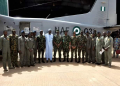
The Nigerian Navy has demonstrated its operational readiness and capabilities in a four-day sea inspection exercise, codenamed ‘Nchekwa Oshimili’ 2023, which ended on Sunday in Onne, Rivers State.
‘Nchekwa Oshimili’, which translate to “Guarding the Seas“, is an annual event to evaluate the performance and proficiency of the naval fleet, involved 13 naval ships, 88 smaller naval craft, two helicopters, four operational bases, 4,000 naval personnel and two units of the navy’s Special Boat Service, Nigeria’s elite special naval service.
The exercise covered the nation’s maritime environment as well as the Gulf of Guinea, a strategic waterway for international trade and communication.
The Minister of State for Defence, Muhammad Bello Matawalle, who was on board the Nigerian Navy’s amphibious ship NNS KADA, commended the navy for its impressive performance in maintaining maritime security along Nigeria’s coast and in the Gulf of Guinea.
He said the navy’s operations have led to a drastic reduction of maritime crime, which has improved economic activities in the region.
He cited the increase in oil production and the removal of Nigeria from the International Maritime Bureau’s (IMB) list of piracy-prone nations as some of the achievements of the navy.
He also said the exercise Nchekwa Oshimili, would further enhance the navy’s capabilities and cooperation with other maritime stakeholders in combating maritime crimes.
The Chief of Naval Staff, Vice Admiral Emmanuel Ogalla, said the exercise was designed to test the operational readiness, combat effectiveness and interoperability of the naval fleet.
He said the exercise also aimed to improve the navy’s skills in maritime domain awareness, intelligence gathering, surveillance, interdiction, boarding, search and seizure, air operations, amphibious operations, special operations, gunnery, communication and logistics.
He said the exercise was conducted in line with the navy’s strategic plan and vision to develop a credible naval power in fulfillment of the nation’s maritime security objectives.
He thanked the minister and other dignitaries for their support and encouragement to the navy.
He also appreciated the cooperation and collaboration of other security agencies, maritime stakeholders and the host communities for the successful conduct of the exercise.
Piracy is a serious problem that affects maritime trade in Nigeria in various ways. Some of the impacts are:
Piracy causes losses of revenue and resources for the Nigerian economy. For example, Nigeria has lost nothing less than $2.7 billion in four years to the menace of piracy. Piracy also reduces the volume of crude oil production and export, which is the main source of income for the country. For instance, in 2016, Nigeria lost 27.1 million barrels of crude oil to piracy attacks.
Piracy disrupts the flow of international seaborne trade and communication in the Gulf of Guinea, which is a strategic waterway for Nigeria and other countries in the region. Piracy affects the movement of goods and people, increases the cost of shipping and insurance, and discourages foreign investment and trade. According to a report by the International Maritime Bureau (IMB), Nigeria accounted for 41 out of 57 piracy incidents in the Gulf of Guinea in 2019.