
A combined detachment of Algeria’s People’s National Army (ANP) has seized two first-person view (FPV) attack drones, along with mortars, rocket launchers and heavy machine guns, from an arms cache at Bordj Badji Mokhtar in the far south of the country, close to the border with Mali, the Ministry of National Defence (MDN) announced on Saturday 21 November 2026. The ministry said the cache was found during the week “thanks to the optimal exploitation of intelligence”, and described the operation as a blow to “criminals and cross-border arms trafficking networks”, according to L’Express DZ and TSA. It did not name any group.
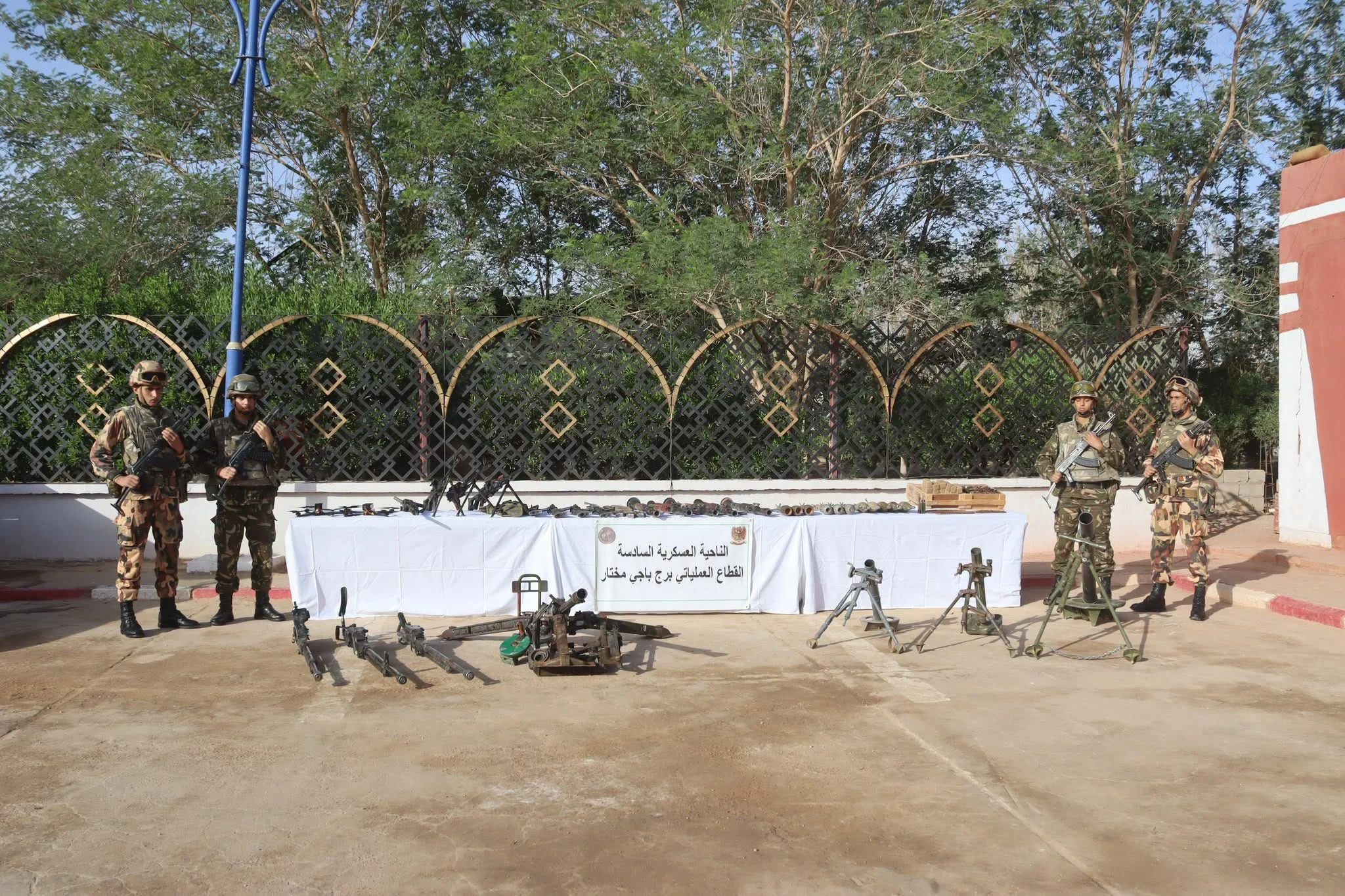
The MDN listed one all-terrain vehicle, one 82 mm mortar, two 60 mm mortars, five RPG-7 rocket launchers, three 12.7 mm machine guns, one 14.5 mm machine gun, four light machine guns, four Kalashnikov-type assault rifles with accessories, two drones, six 82 mm mortar bombs, five rockets with five propellant charges for the RPG-7s, and 2,828 rounds of various calibres. Weapons caches are found regularly along this stretch of frontier. The drones are what set this one apart.
Ten-Inch Strike Drones Built for Jamming
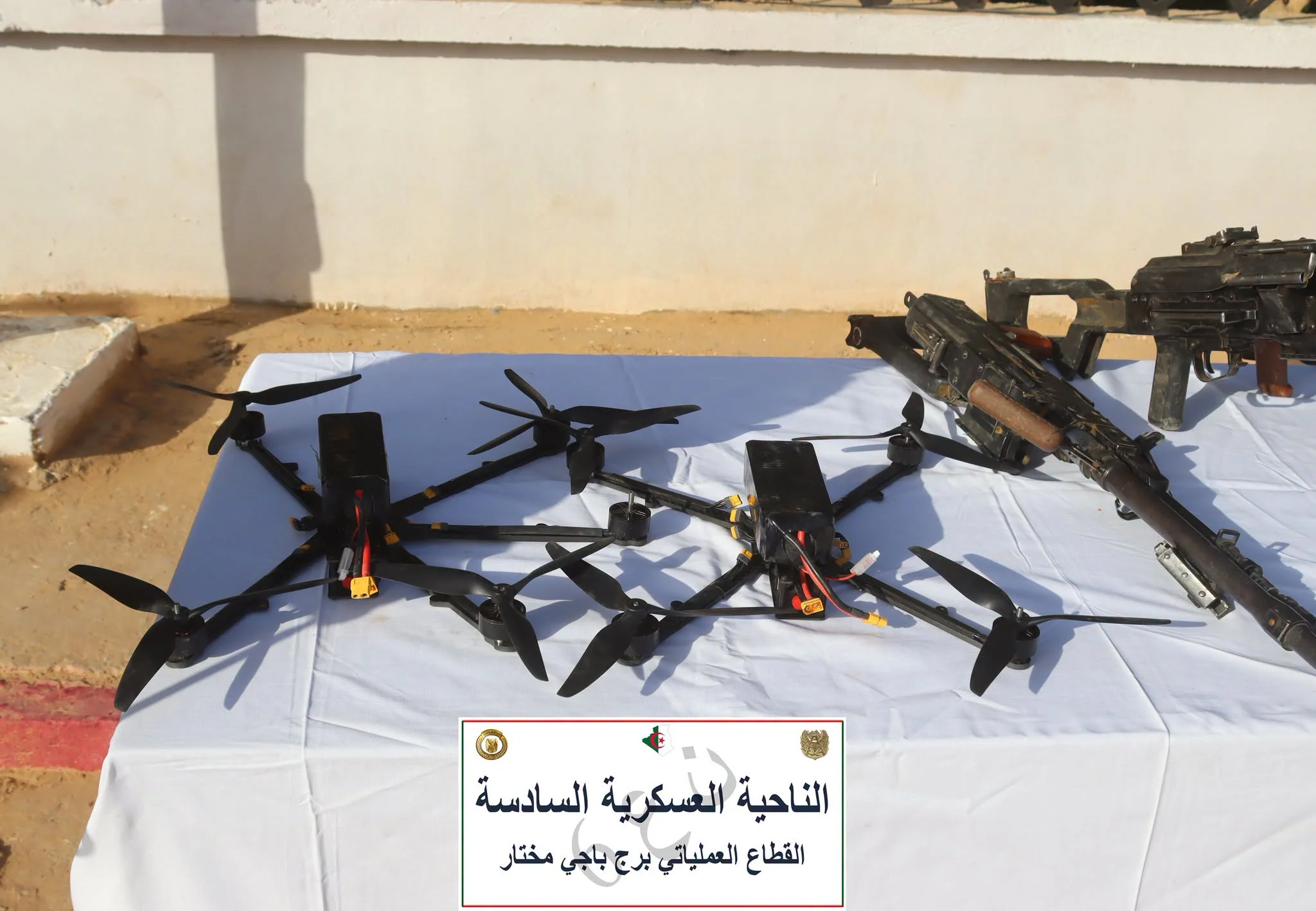
Photographs released by the MDN show two large quadcopters with carbon-fibre frames. Algerian defence analyst Akram Kharief of Menadefense identified them as the FLH10, a generic 10-inch kit made in China that has been imported and modified in large numbers by both Ukraine and Russia. Operators on both sides of that war use the 10-inch format to strike 15 to 25 km behind the line, to carry heavier warheads against armour and fortifications, and to drop munitions.
Kharief said the more telling detail is the electronics. The drones carry transmit and receive connectors and an onboard unit, known as a Sky Module or Skyend Module, in place of the usual video transmitter and radio receiver. Such links are built to keep working in an electronic warfare environment. The photos show no warhead, firing module or fibre-optic spool, but Kharief judged both aircraft ready for one-way attack missions. In a separate analysis, he put their payload at about 3 kg, roughly one RPG warhead, and their range at 20 to 30 km depending on the load, and noted that the frames were imported rather than 3D-printed locally. Paired with an anti-tank warhead such as the PG-7VL, which weighs about 2.6 kg, a 10-inch FPV drone becomes a precise loitering munition. Kharief warned that the flat, open terrain of southern Algeria makes the configuration more dangerous still.
He added that the hardware alone cannot settle whether the drones are Ukrainian or Russian, since the two countries field almost identical models.
A Rear Base for Mali’s War?
Nothing in the MDN statement suggests the weapons were meant for use in Algeria. Kharief argued that the cache may have been a rear depot for the war across the border, or a shipment being moved to armed groups in Mali by traffickers. He named two likely owners: the Azawad Liberation Front (FLA), the main Tuareg separatist coalition, and Jama’at Nusrat al-Islam wal-Muslimin (JNIM), the al-Qaeda affiliate. Because JNIM shows little activity along the Algerian section of the border, he considered the FLA the more likely of the two.
Both groups have used drones in northern Mali for some time. Ukrainian-supplied drones first appeared there in 2024 and 2025, used by the FLA and probably by JNIM, and Military Africa has reported on Ukrainian drone teams operating in Mali, Libya and Sudan. In July 2024, at the battle of Tinzaouaten near the Algerian frontier, Wagner fighters, the FLA and JNIM all used FPV drones, and fibre-optic models followed from 2025. The rebels have also taken a steady toll on Mali’s helicopters and aircraft, while Russia’s Africa Corps has answered with its own drone and air campaign.
From Turkish Drones to Small Quadcopters
Algeria has faced drones on its borders before, but from regular armies. On the eve of 1 November 2021, three Algerian lorry drivers were killed in a strike attributed to a Moroccan Bayraktar TB2. On 1 April 2025 the ANP shot down a Malian Bayraktar AKINCI near Tinzaouaten, setting off a deep diplomatic crisis between Algiers and Bamako. Kharief said Algeria’s air defences can detect and engage large Turkish drones at range, but small, fast FPV quadcopters weighing a few kilograms are far harder to spot and identify.
The discovery comes as Algeria takes a more active role across its southern frontier. Algiers donated Mi-24 and Mi-171 helicopters to Niger in August, and its army chief has said ANP units deployed to Niger at Niamey’s request to guard shared energy sites.
Counter-Drone Gaps on the Sahara Frontier
Until now the FPV war in the Sahel had been fought on the Malian side of the border. The seizure at Bordj Badji Mokhtar shows that the equipment is now present on Algerian soil, whether in transit or in storage. For the ANP, that means extending short-range counter-drone coverage, electronic detection and jamming to remote border posts and patrols that were built to stop smugglers’ vehicles rather than small aircraft. The MDN has not said whether it will disclose the drones’ origin or the owners of the cache, but its forces along a border of more than 1,300 km will now have to plan for a threat that until recently belonged to the front lines of Ukraine.