

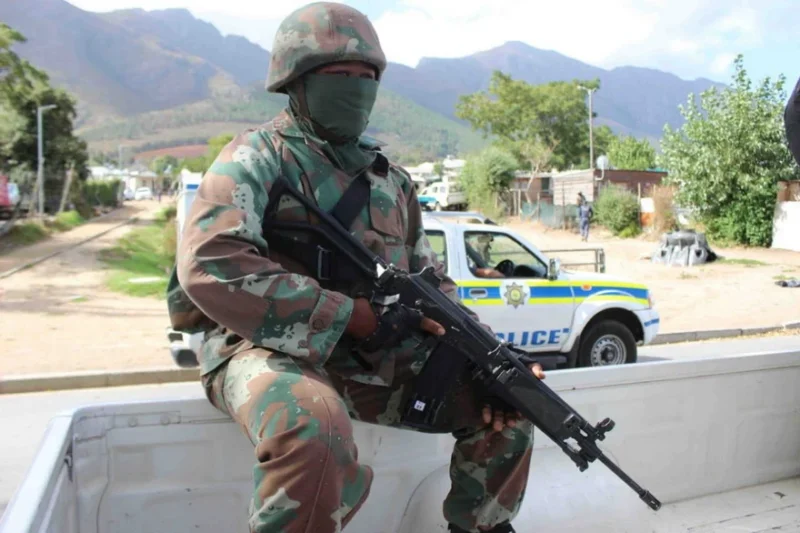
The Armaments Corporation of South Africa (Armscor), the country’s state arms procurement agency, has issued a Request for Information (RFI) as it explores options to replace the Vektor R4 and R5 assault rifles, should the South African Army decide to pursue such a move. The RFI, reference 02061-900-013, closed on 30 September 2026, and its contents were first reported by DefenceWeb on 7 September.
The Armscor document makes it clear that the exercise is meant simply to feed a functional study rather than trigger an immediate procurement process, expressly noting that this “is not a Request for Bid, purely technical information is required, as Bids are not being solicited at this stage.”
Even so, the request is the clearest sign yet that South Africa’s defence establishment has begun to think seriously about what comes after a rifle family that has armed its soldiers for more than four decades. It follows the procurement of new Truvelo sniper rifles under Project Tedu, which renewed part of the Army’s precision small arms inventory, and comes at a time when the South African National Defence Force (SANDF) is working under tight financial limits.
A family of rifles, not a single weapon
What the RFI does call for is detailed technical information on existing “Self-Loading Automatic Rifle Systems” (SLARS) to be submitted to Armscor for review. According to the Armscor document, “a family of weapons is envisaged to address the requirement for an assault rifle or battle rifle and a dedicated marksman rifle.”
That wording leaves the door open to both of the main North Atlantic Treaty Organization (NATO) rifle calibres. An assault rifle would most likely remain in 5.56×45 mm, the calibre the R4 and R5 already use, while a battle rifle would point back towards the heavier 7.62×51 mm round that South African soldiers carried in the R1 until the 1980s. Several armies have moved in this direction in recent years, pairing a standard rifle with a longer-ranged marksman variant built on the same receiver to simplify training and spares.
Technical details to be submitted include charts, drawings and schematics, and should cover core weapon functionality such as ballistics, cyclic operation, structural integrity under NATO pressure-testing standards, ergonomics, thermal management and sighting systems. Thermal management, the rifle’s ability to sustain fire without overheating or losing accuracy, and sighting, which now often means optics as standard issue rather than iron sights, are two areas where modern designs have moved on considerably since the R4 was introduced.
Three tiers of local support
Beyond this, Armscor places a keen emphasis on local logistical support, requesting that a substantial amount of information be included in this regard as part of submissions made to it. This is to be done across three distinct tiers of information.
The first tier covers the weapon system itself: its barrel, receiver, bolt carrier, fire control mechanism, furniture and interfaces. The second tier addresses support and sustainment, including ammunition in 5.56×45 mm and/or 7.62×51 mm, magazines, and ancillaries such as optics as well as cleaning and field maintenance kits.
The third tier concerns integrated logistics support (ILS). Here Armscor asked for user and technical documentation, specialised tooling, reliability data, the life cycle of critical components, the warranty and local support period on offer, and training support.
The weight placed on local sustainment reflects a long-standing priority in South African defence acquisition. A service rifle is one of the most numerous items in any army’s inventory, and the ability to make barrels, bolts and other wear parts at home, rather than import them for decades, has direct consequences for the domestic small arms industry and for the country’s freedom of action in a crisis.
How to respond, and who to contact
Armscor said companies could invite it to demonstrations of their systems, although these were not a requirement of the RFI. Such invitations were to be sent to [email protected].
The RFI document itself was obtainable from Armscor’s Supply Chain Management division via [email protected], while responses were to be sent to the project team by email or post, for the attention of Mr L Sibiya. With the 30 September 2026 deadline now passed, the submissions received will feed the functional study, and any eventual acquisition would have to go through a separate, formal procurement process.
Four decades of the R4 and R5
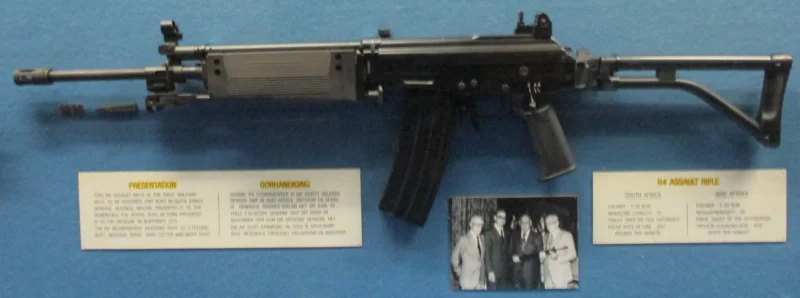
The R4 and R5 are licensed variants of the Israeli-designed Galil assault rifle, and have been in service with South African security forces since the early to mid-1980s. They replaced the Belgian-designed 7.62×51 mm FN FAL battle rifle, produced locally as the R1, which had been in use since the 1960s.
The R4 entered service in 1980 as the standard rifle of the then South African Defence Force (SADF). It was produced by Lyttelton Engineering Works (LIW), which later traded as Vektor and became part of Denel Land Systems. South African engineers adapted the Galil ARM for local conditions, fitting a longer stock suited to the average South African soldier, using high-strength polymer for the stock and magazine, and deleting the carry handle. The rifle uses a Kalashnikov-derived gas-operated rotating bolt, weighs about 4.3 kg, fires at between 600 and 750 rounds per minute and feeds from a 35-round magazine.
The R4 is primarily used by the South African Army and has proven to be durable and reliable. The R5, a shorter carbine version based on the Galil SAR with a barrel about 130 mm shorter, is used more widely across the South African Army, South African Air Force, South African Navy, South African Military Health Service and South African Police Service. A still more compact R6 was developed in the 1990s for armoured vehicle crews. Production of the family is estimated at around 420,000 rifles.
The rifle has also spread across the continent. R4 and R5 rifles have been used by Eswatini, Lesotho, Malawi’s police service, the Central African Republic and Rwanda, while the Republic of the Congo took delivery of 15,900 rifles in 1996 and 1997. South African troops have carried the R4 in operations from the Border War to United Nations peacekeeping in the Democratic Republic of Congo and the Southern African Development Community (SADC) mission in Mozambique’s Cabo Delgado province.

Questions in Parliament over the AK201
The RFI has not passed without controversy. Writing in DefenceWeb on 22 September, Carl Niehaus, an Economic Freedom Fighters (EFF) Member of Parliament who sits on the Portfolio Committee on Defence and Military Veterans and the Joint Standing Committee on Defence, said industry was reading the request against a commercial pitch for the Kalashnikov AK201, a 5.56 mm member of the Russian AK-200 family, and other Kalashnikov-pattern rifles shown in South Africa that same month.
In his opinion piece, Niehaus cited claims that about 300 AK201 rifles had been bought for trials but not delivered, and that the arrangement under discussion would see receivers imported while some parts were assembled and some wear parts, such as barrels and bolts, made locally. He also referred to allegations of an advance payment to a supplier or consultant without a valid delivery contract, and to an estimated 30-year programme cost, figures he said must be tested. None of these claims has been confirmed by Armscor or the Department of Defence.
Niehaus has argued that the R4 and R5 are ageing but can be improved, noting that Denel engineers reportedly say they can produce an upgraded R4/R5 more cheaply, and that a Czech CZ option, including an offer to buy existing R4 stock for recycling, has also been put forward. He has called for Parliament to be told whether a decision to move away from the R4 and R5 has already been taken, and for any choice to sit within “Journey to Greatness”, the force-evolution strategy that Cabinet adopted on 6 May 2026. In a follow-up article on 13 October, he said he had asked Armscor at the committee’s 9 October meeting about the RFI and whether any AK201 rifles had previously been ordered.
Denel, the budget and the next service rifle
Whatever the functional study recommends, money will shape the outcome. Replacing the rifles of an army, and potentially the other services and the police, is a large and long-term commitment at a time when the South African defence budget continues to shrink in real terms. Recent major programmes, including the selection of Milkor to supply armoured personnel carriers, have also drawn scrutiny over how Armscor runs its acquisitions.
Industrial policy is the other deciding factor. Denel, the state-owned group whose Land Systems division built the R4 and R5, is emerging from years of financial distress, and Armscor and Denel have recently moved to strengthen their collaboration in support of the SANDF. The heavy emphasis on local support in the RFI suggests that whichever rifle South Africa eventually chooses, whether an upgraded R4, a new local design or a foreign system, its ability to be built, maintained and supported in the country will weigh as heavily as its performance on the range.