

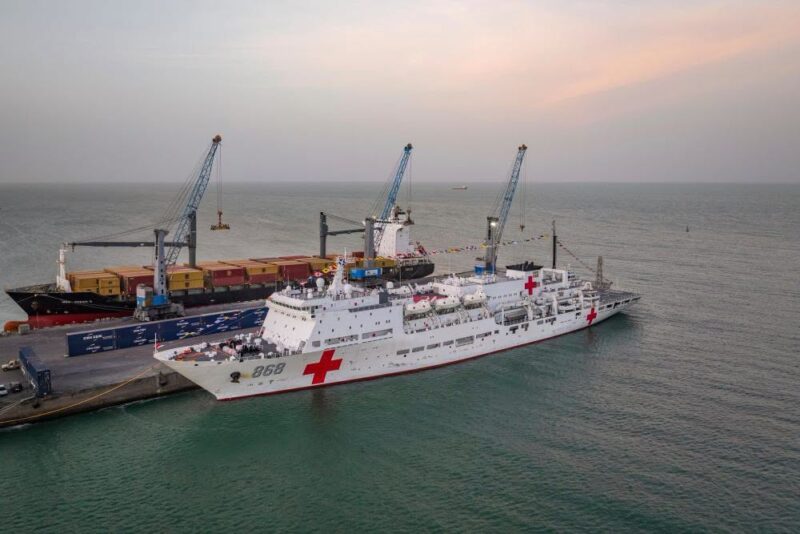
The Chinese People’s Liberation Army Navy (PLAN) hospital ship Auspicious Ark docked in Conakry, Guinea, on 3 October and departed on 10 October after a seven-day goodwill visit, the first stop by a Chinese naval hospital ship in that country.
The call was part of Mission Harmony-2026, the twelfth edition of a PLAN medical diplomacy programme that began in 2010. Guinean government and military officials, the Chinese ambassador to Guinea, the defence attache, embassy staff, local residents and representatives of overseas Chinese communities and businesses met the ship at the Port of Conakry on arrival. A separate mobile team visited the China-Guinea Friendship Hospital for academic exchanges and a military camp for consultations and treatment, while Chinese and Guinean service members played a friendly basketball match.
Guinea’s prime minister, Amadou Oury Bah, toured the ship and attended a deck reception during the visit, according to Xinhua. A farewell ceremony was held at the port when the ship left on 10 October, with senior Guinean defence and foreign affairs officials among those seeing it off.
The Guinea stop followed two earlier West African calls on the same deployment. The ship spent seven days in Nouakchott, Mauritania, in mid-September, where medical teams handled more than 1,600 consultations in a single day and delivered a baby for a woman with a high-risk pregnancy. It then sailed to Dakar, Senegal, arriving 25 September for its first-ever visit to that country. Over the week in Dakar the crew logged 6,060 patient visits, performed 29 surgeries and ran 61 health checkups, with shore teams adding 350 further consultations and two rounds of health training for 150 people.
Auspicious Ark left Qingdao, in eastern China’s Shandong Province, on 22 July to begin the voyage, its first overseas mission. The deployment is scheduled to run more than 200 days and will take the ship through multiple African and South Asian ports before it returns home.
The vessel is a Type 920 hospital ship, the third in a class that also includes Peace Ark and Silk Road Ark, and entered service with the PLAN’s North Sea Fleet in 2025. At roughly 10,000 tonnes, it carries 18 clinical departments and five auxiliary diagnostic units, giving it the ability to run more than 60 types of medical examinations, treatments and procedures across general surgery, orthopaedics, obstetrics and gynaecology, and ophthalmology, among other specialties. Eight onboard operating rooms allow simultaneous surgeries, and an embarked helicopter extends the ship’s reach for medical evacuation. The roughly 100-strong medical team aboard is drawn mainly from the PLA Northern Theatre Command Navy, with additional staff from the Naval Medical University.
Peace Ark carried out the first ten Mission Harmony deployments and has, according to Chinese state media, called at 49 countries and treated more than 370,000 patients since 2010. Silk Road Ark ran the eleventh mission, which concluded in April this year. Auspicious Ark’s current voyage extends that pattern to a third hull and a longer operating tempo, letting the PLAN keep one hospital ship available for routine fleet duties while another is at sea on a Mission Harmony tour.
The ship’s value lies less in any single procedure than in the platform itself: a self-contained surgical and diagnostic facility that can begin treating patients within hours of tying up, without relying on a host nation’s hospital infrastructure. That capability sits inside a wider pattern of PLAN activity along the West African coast and the broader African littoral. In July 2024 the 43rd Escort Group called at Lagos, Nigeria, Pointe-Noire in the Republic of Congo, and ports in Ghana and Gabon. In July 2026 Ivory Coast’s navy commissioned two Chinese-donated patrol vessels at the Plateau Naval Base in Abidjan. And in 2025 the PLAN formally rotated its presence at the Project 141 overseas support base in Doraleh, Djibouti, with the 48th Naval Escort Group taking over operational duties there.
None of these activities are formally linked, and a hospital ship visit carries none of the operational weight of a support base or a patrol vessel transfer. But taken together they describe a steadily expanding routine of Chinese naval contact across African ports, mixing humanitarian outreach, equipment transfers and basing arrangements. Analysts tracking China’s maritime posture in Africa generally read hospital ship tours as the softer end of that spectrum, building familiarity with ports and officials that can pay off later in access or goodwill, even when no military logistics are directly at stake.
Guinea’s Overseas Chinese Association chairman, Chen Renbing, said the visit marked “a new level in the friendship between Guinea and China,” a comment that fits the diplomatic framing Beijing has placed on the mission. China’s defence ministry has described Mission Harmony-2026 as intended to deepen cooperation and contribute to what it calls a maritime community with a shared future, alongside its Global Security Initiative.