

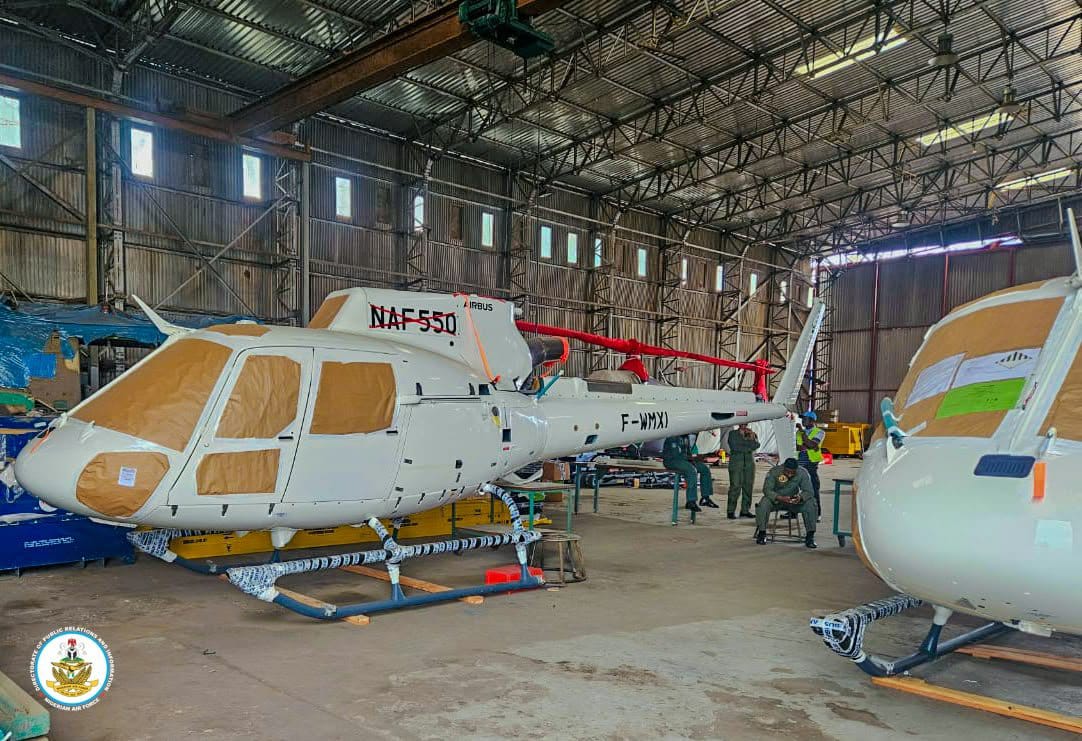
The Nigerian Air Force (NAF) has expanded its fleet with five new helicopters, receiving three Leonardo AW109 Trekker B aircraft in Lagos on September 15, 2026, following the earlier delivery of two Airbus H125 utility helicopters.
The NAF’s Director of Public Relations and Information, Air Commodore Ehimen Ejodame, confirmed the arrivals in a statement issued in Abuja on 16 September 2026. He said the 3 Trekkers are part of a batch of 10 ordered from Leonardo Helicopters of Italy, with the remaining 7 due before the end of 2026.
Chief of the Air Staff, Air Marshal Sunday Kelvin Aneke, called the delivery “another milestone in the Federal Government’s sustained investment in the modernization and re-equipment of the NAF”. He said the new airframes would increase aircraft availability and give field commanders more flexibility in tasking helicopters across the NAF’s various theatres of operation. “The arrival of these 5 helicopters provides greater flexibility in the employment of airpower in support of ground troops in ongoing operations”, Aneke said, according to the NAF statement.
The Trekker order traces back to a 2018 contract for 6 A109-family helicopters, placed under then-Chief of the Air Staff Air Marshal Sadique Abubakar. The NAF inducted its first two AW109 Power variants in April 2019 and a second pair in January 2020. In October 2024, air force officials met Leonardo executives in Rome to finalize a follow-on order for 10 more Trekkers, bringing planned holdings to 16 airframes once deliveries close out, part of a wider package that also included 24 M-346 fighter-ground-attack jets.
President Bola Ahmed Tinubu formally inducted 2 Trekkers into service in May 2025, and the Nigerian Navy took delivery of 3 of its own Trekkers for maritime security duties in November 2024. NAF technicians completed a six-week maintenance and systems course on the type at Leonardo’s Sesto Calende facility in early 2026, ahead of the fleet’s expansion.
Leonardo Helicopters built the Trekker, a light, twin-engine, multi-role helicopter. It runs on two Pratt & Whitney Canada PW207C engines, cruises at roughly 274 to 281 km/h, and can range out to about 830 km with auxiliary tanks, giving it an endurance of just over 4 hours. Its maximum internal weight is 3,175 kg, and it can lift external loads of up to 3,350 kg on a cargo hook. It carries one or two pilots plus up to 7 passengers, with wide sliding doors that speed loading for medevac or troop transport. For the NAF, Aneke said the type will support intelligence, surveillance, and reconnaissance, close air support, armed escort, and combat search-and-rescue, alongside other joint missions backing ground forces.
The H125, a single-engine utility helicopter from Airbus, fills a different role. Powered by a Safran Arriel 2D engine with dual-channel digital control, it cruises near 251 km/h and carries external sling loads of up to 1,400 kg, making it useful for logistics runs, casualty evacuation and light surveillance in terrain the heavier Trekker might not reach as efficiently. Its high-altitude performance- the type has landed on the summit of Mount Everest- gives it margin in Nigeria’s varied climate and elevation.
Both aircraft slot into a rotary-wing fleet the NAF has been rebuilding for nearly a decade, largely to support operations against Boko Haram and Islamic State West Africa Province in the northeast, and against armed banditry and kidnapping gangs in the northwest and north-central states. Ejodame said the added rotary-wing capacity would strengthen support for joint forces fighting those threats. Helicopters offer troops on the ground something fixed-wing jets cannot: the ability to loiter, extract casualties, and land in confined spaces close to contact.
Nigeria’s Air Force has also been expanding its fixed-wing fleet through the M-346 order and other acquisitions, part of a broader effort by the Federal Government to replace aging Soviet- and Western-era airframes that have struggled with maintenance and spare-parts availability. Analysts tracking African air forces have noted that fleet modernization of this kind depends as much on sustained maintenance and training pipelines as on the aircraft themselves, which is one reason the NAF has sent technicians to Italy for type-specific courses rather than relying solely on contractor support at home. With seven more Trekkers still due this year, the NAF’s rotary fleet is set to grow further before 2026 closes out.