

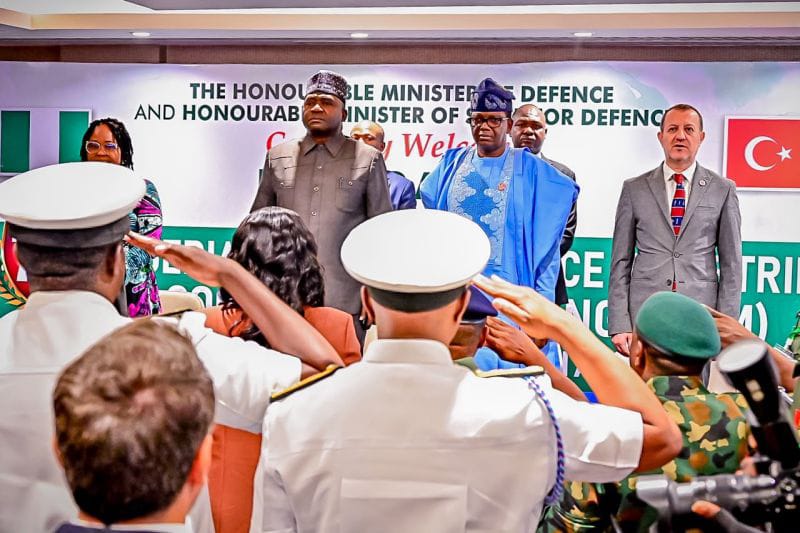
On August 26, 2026, Nigeria and Turkey cemented a strategic shift in their bilateral military relations during the 7th Defence Industry Business Forum in Abuja, transitioning from direct arms procurement to joint manufacturing and technology transfer. The meetings build upon a massive drone procurement contract signed earlier this year, laying the practical groundwork for a self-reliant Nigerian defence industrial base.
The forum, held at the Transcorp Hilton Hotel in Abuja, featured high-level negotiations led by Nigeria’s Minister of Defence, General Christopher Gwabin Musa (retd), and Turkey’s Vice President of the Presidency of Defence Industries, Gökhan Uçar. Both delegations formalized minutes from the 7th Defence Industry Cooperation Committee (DICC) meeting. This formalization commits both nations to practical investments in local production rather than standard equipment imports.
General Musa emphasized that the primary objective is to translate long-standing relations into sustainable capabilities. “We must progressively move beyond a predominantly buyer-seller relationship towards a more balanced and mutually beneficial partnership”, he stated, built on joint production, local manufacturing, research and development, and maintenance, repair and overhaul, known as (MRO).
Nigeria’s Minister of State for Defence, Dr. Bello Mohammed Matawalle, said the gathering came at a critical point for Nigeria’s defence-industrial ambitions and that the task now was to turn policy into working factories and production lines. “The real opportunity lies in translating this policy and legislative framework into actual industrial capability”, Matawalle said.
On the Turkish side, officials described the meeting as an opening for closer business ties between the two countries’ defence sectors. This push for indigenous manufacturing relies on the legal framework established by Nigeria’s Defence Industries Corporation of Nigeria (DICON) Act 2023. Major General Babatunde Ibrahim Alaya, Director-General of DICON, noted during the event that actual value stems from merging Turkish technical expertise with local human capital. The focus now rests heavily on establishing localized maintenance, repair, and overhaul (MRO) facilities.
The August forum stems directly from earlier diplomatic foundations. On January 27, 2026, Nigerian President Bola Ahmed Tinubu signed a core Defence Cooperation Agreement in Ankara. That state visit produced 9 comprehensive accords covering military training and intelligence sharing. As a direct result, Turkey currently provides specialized counterterrorism training for over 200 Nigerian special forces personnel.
In 2022, Nigeria and Turkey entered talks on defence collaboration in counter-terrorism support as well as the acquisition of various military hardware which may include attack helicopters, armed drones, and other infantry systems. Subsequently, in the same year, leading Turkish defence companies pitched their hardware to the Nigerian military leadership in a bid to make some sales. Amongst the companies; TUSAŞ, OTOKAR, Roketsan, BMC, Tais Shipyard, Katmerciler, ASELSAN, TAI and 10 others were in Abuja to attend the 5th Turkey-Nigeria Defence Industry Consultation Meeting. The delegation was led by Savunma Salihi Sanayii where they met with the Nigerian Minister of Defence Major General Bashir Magashi. Turkish Aerospace Industries (TAI) later announced it will supply six T-129 ATAK helicopters to Nigeria under a recent contract signing.
In May 2026, Turkish manufacturer DASAL Aviation Technologies signed a framework supply and technology-cooperation agreement with Nigerian defence firm NIGUS International Investment Limited at the SAHA 2026 international defence exhibition in Istanbul. The deal covers the supply and local assembly of a large Unmanned Aerial Vehicle (UAV) for the Nigerian military. The package covers 100,000 DASAL MIKON loitering munitions, small drones built to strike a target and destroy themselves in the process, plus 200 FALCON R556 multi-rotor systems and 100 PUHU cargo drones for logistics runs, to automate tactical logistics and reduce convoy ambushes. The military specifically selected the C75 and C100 electric rotary-wing models to resupply forward operating bases with ammunition and rations. NIGUS will coordinate local assembly and maintenance, repair, and overhaul (MRO) work, meaning the day-to-day servicing and repair of the aircraft, inside Nigeria rather than shipping units back to Türkiye. This localized infrastructure ensures the newly acquired UAVs maintain quick operational readiness without relying on extended foreign supply routes.
During the same SAHA expo, the DICON-D7G joint venture showcased its own indigenous weapons to the global market. This exhibition demonstrated that Nigeria is actively co-producing infantry combat equipment, assault rifles, and armored vehicles locally. By securing electronics integration and technical know-how from leading Turkish firms like ASELSAN, DICON aims to rapidly upgrade its domestic product lines.
Turkey’s broader defence strategy involves offering flexible export policies combined with high-tech industrial cooperation. Nigeria serves as the geographic and economic anchor for this doctrine in Africa. The Turkish approach provides a viable third way for African states seeking to move beyond traditional arms dependencies on Western powers, Russia, or China.
On June 3, 2026, Turkey finalized a military financial cooperation agreement with Cameroon in Ankara. Turkish Minister of National Defence Yaşar Güler and Cameroonian Defence Minister Joseph Beti Assomo signed protocols delivering a step-by-step roadmap for financial aid and military resource transfers.
These localized production lines and MRO hubs position Nigeria to serve as a primary defence supplier for the wider Economic Community of West African States (ECOWAS) region. By domesticating maintenance and assembly, the Nigerian military can sustain high-tempo operations against armed groups without suffering from external supply bottlenecks.
Nigeria’s Minister of Defence, Gen. Christopher Gwabin Musa (retd.), said the real test of the partnership would not be how many platforms Turkey delivers but whether Nigerian personnel and institutions gain the skills to sustain and improve that equipment themselves. Beyond hardware, Nigerian officials pointed to unmanned systems, artificial intelligence, and cyber capabilities as priority areas for co-development, reflecting how irregular warfare in the Sahel and the Lake Chad basin has increasingly relied on cheap, disposable drones rather than expensive manned aircraft.
The integration of loitering munitions and heavy-lift cargo UAVs will change how Nigerian infantry units conduct counter-insurgency patrols. Ground forces will soon possess organic close air support and aerial resupply capabilities, sharply reducing their reliance on vulnerable road convoys and manned rotary-wing assets.