

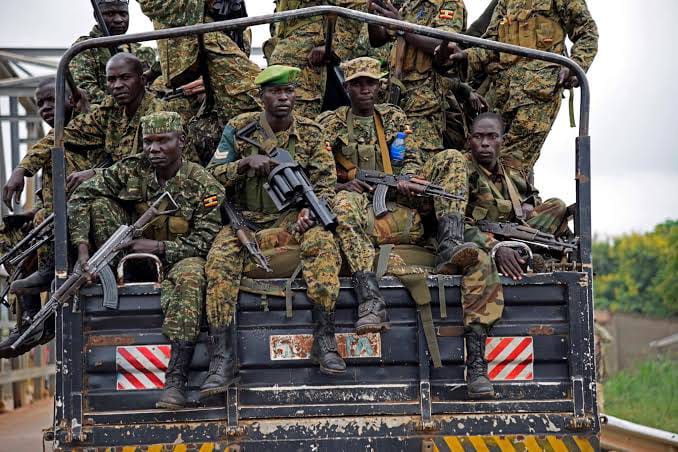
On Friday, August 28, 2026, a senior Ugandan military official confirmed that all Ugandan forces are scheduled to conclude their deployment in Somalia by August 1, 2027. This declaration provides a definitive end date for a deployment that has lasted nearly two decades.
General Muhoozi Kainerugaba, Chief of the Uganda People’s Defence Forces (UPDF), said in a public post that “We are withdrawing completely from Somalia by the 1st of August 2027”, adding emphatically that “There will not be UPDF in Somalia after that”. He did not provide specific operational details about this withdrawal, nor did he indicate whether President Yoweri Museveni, as commander-in-chief, had formally sanctioned this date.
This announcement provides the most explicit timeline presented thus far in the ongoing deliberations on troop reduction, a discussion that has persisted through most of 2026. General Kainerugaba had initially proposed a comprehensive pullout on January 26, to express Uganda’s intent to depart “very soon” after “19 years in Somalia”, without specifying a concrete date. In February, the Ugandan military high command, convened under the chairmanship of President Museveni at State House, Entebbe, resolved to effectively withdraw within one year, provided that the financial impediments affecting the African Union mission were rectified.
Conversely, Defence Minister Kiryowa Kiwanuka, in mid-August, made a different point, suggesting that Ugandan troops would continue their presence in Somalia under a bilateral security agreement, even in the event of the multinational mission’s cessation. General Kainerugaba’s statement on Friday indicates a prevailing inclination towards withdrawal, at least for the present. Uganda initiated the inaugural ground deployment in Somalia in March 2007, operating under the mandate of the African Union Mission in Somalia (AMISOM). This deployment aimed to support the nascent federal government in its efforts against the al-Qaeda-linked insurgent group al-Shabaab.
Kampala is AUSSOM’s largest troop contributor, with roughly 4,500 soldiers on the mission’s approved deployment list. That figure sits alongside a separate bilateral contingent that Uganda has kept in Somalia since 2025 under a security agreement signed with Mogadishu at the end of 2024. Ugandan military sources put that bilateral force at around 2,000 troops, though other reporting from Kampala this year has cited numbers as high as 4,000 to 6,000.
The timing of Kainerugaba’s announcement matters as much as the date itself. The UN Security Council’s current authorization for AUSSOM runs only to December 31, 2026, and covers up to 11,826 uniformed personnel, including 680 police officers. The United States has told the African Union it will not back a further mandate extension that keeps UN-funded logistics flowing to the mission after that date. That logistics arrangement, run through the UN Support Office in Somalia (UNSOS), has an annual budget of roughly $500 million and covers food, fuel, water, medical care and casualty evacuation for AUSSOM troops. UNSOS has backstopped the mission continuously since 2009, taking its current form in November 2015.
Uganda hosted an extraordinary summit in Kampala from July 29 to 31 for AUSSOM’s troop-contributing nations, Burundi, Djibouti, Ethiopia, Egypt, Kenya, Uganda and Somalia, to weigh the mission’s options. Museveni told delegates that African states would keep supporting Somalia’s stabilization even if outside partners cut funding.
Uganda’s presence in Somalia has fluctuated over the years rather than tracked a straight line down. At its peak, the UPDF contingent under AMISOM ran close to 6,000 soldiers; later phased drawdowns, including a cut of roughly 2,000 troops in 2023 tied to UN Security Council resolutions on the ATMIS transition, brought the multilateral force down toward its current level. Uganda has floated full or partial pullouts more than once over the mission’s life, and previous timelines have slipped or been walked back as circumstances on the ground changed. The Somali National Army (SNA) would need to backfill a swathe of territory around the capital that Ugandan troops have held since the AMISOM years, including approaches to Mogadishu that have seen repeated al-Shabaab attacks.
Kainerugaba’s August 1, 2027 date falls seven months after AUSSOM’s current UN mandate expires, which leaves an open question about which framework- AUSSOM, a reshaped AU mission, or Uganda’s bilateral arrangement with Mogadishu, would govern any residual Ugandan presence in the interim. Egypt’s own troop contribution to AUSSOM has already been delayed by funding and logistics bottlenecks, a sign that the mission’s broader force-generation problems extend well beyond Kampala’s decision.