


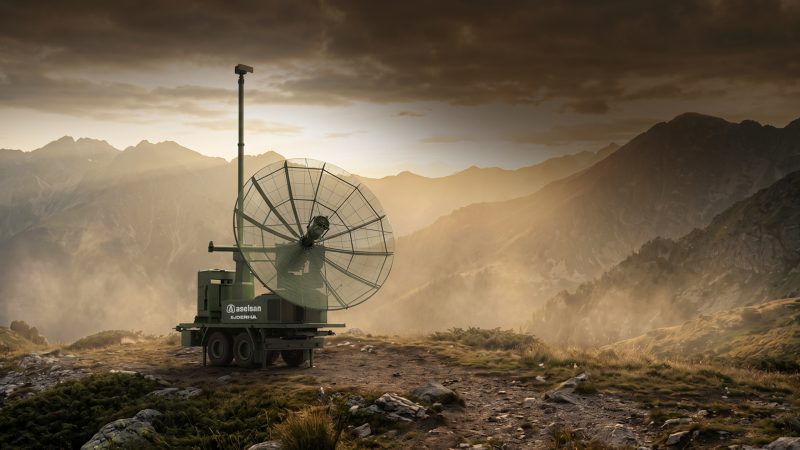
ASELSAN is bringing its expanding portfolio of advanced airpower and counter-UAV capabilities to AAD in South Africa, showcasing solutions spanning airborne sensing and targeting, precision strike and layered protection against unmanned threats.
Rather than focusing on individual platforms, the display illustrates how ASELSAN is building an increasingly connected portfolio spanning reconnaissance and targeting, precision engagement and protection against unmanned aerial threats. These capabilities extend from systems carried by combat aircraft and UAVs to integrated solutions designed to protect deployed forces and critical assets.
ASELFLIR 500 for Long-Range Reconnaissance and Targeting
One of the main airborne systems on display is ASELFLIR 500, ASELSAN’s electro-optical reconnaissance, surveillance and targeting system developed for fixed-wing aircraft and UAVs.
ASELFLIR 500 combines daylight, infrared and short-wave infrared imaging with laser targeting capabilities in a compact, highly stabilized system. Designed for day-and-night operations, it delivers high-resolution imagery and long-range detection and tracking, while its advanced stabilization enables precise and reliable performance from airborne platforms.
The system also incorporates artificial intelligence-based image processing, multi-target tracking and accurate target location capabilities. Its ability to operate at high altitude and in very low temperatures makes it particularly suited to long-endurance UAV operations.
ASELFLIR 500 represents an important part of ASELSAN’s growing airborne electro-optical portfolio, supporting missions ranging from intelligence, surveillance and reconnaissance to target acquisition and designation.
TOLUN Family Expands Precision-Strike Options
AAD also provides a showcase for ASELSAN’s expanding TOLUN family of 250 lb-class precision-guided munitions. The company is presenting TOLUN P, TOLUN L and TOLUN F, which offer different effects against a range of target types while sharing the same compact weapon concept.

TOLUN P is designed primarily for hardened and armored targets. Its penetration warhead can defeat reinforced structures, while its long-range guidance and resistance to navigation jamming allow it to be used in demanding operational environments. The weapon can be carried by both fighter aircraft and UAVs, with certified platforms including the F-16, AKINCI, ANKA-III, BAYRAKTAR TB3 and KIZILELMA.
TOLUN L adds laser guidance to the family, providing greater flexibility against both stationary and moving targets. The weapon combines precision engagement with a fragmentation-effect warhead and is intended for missions where the target may need to be designated during the final stage of engagement.
TOLUN F, meanwhile, is built around a fragmentation warhead and proximity capability, making it suitable for a different set of targets than the penetration-focused TOLUN P. Like the other members of the family, it is designed for long-range, day-and-night operations and can be carried in multiple configurations.
A key feature of TOLUN family is the ability to carry several weapons on a single aircraft station through ASELSAN’s SADAK system. This allows multiple targets to be engaged during the same sortie while increasing the number of precision weapons available to the platform.
The development of P, L and F variants shows how ASELSAN is turning TOLUN into a broader precision-strike family rather than a single-purpose weapon, giving operators different warhead and guidance options around a common concept.
A Layered Response to the Drone Threats
Counter-UAV technology is another major focus of ASELSAN’s AAD presence. The company’s DRONEDEF architecture combines detection, electronic attack and several hard-kill options under a common command-and-control structure to counter mini- and micro-UAV threats.
Four systems demonstrate the layered nature of the concept: İHTAR, GÖKBERK, EJDERHA and KORKUT 25. İHTAR provides detection, tracking and electronic countermeasure capabilities against hostile UAVs. Where a drone depends on a conventional control or communication link, the system can disrupt that connection and neutralize the threat without requiring a physical engagement.
As the threat becomes more sophisticated, counter-UAV systems must offer more than conventional jamming. EJDERHA uses high-power electromagnetic energy to disrupt the electronic systems of UAVs, providing an alternative against threats that may be resistant to conventional electronic countermeasures. GÖKBERK adds a laser-based hard-kill capability, enabling drones to be precisely tracked and physically neutralized through directed-energy engagement. KORKUT 25 provides the kinetic layer with its airburst weapon capability, offering another option against small and maneuvering aerial targets.
The value of DRONEDEF lies in bringing these different technologies together. Instead of relying on a single countermeasure for every drone, the system can select an appropriate response depending on the threat. This is becoming increasingly important as armed forces encounter a wider mix of conventional, autonomous, fiber-optic-controlled and swarm UAVs.
A Broader Airpower Portfolio
ASELSAN’s presence at AAD reflects the broader evolution of its airpower portfolio, with technologies designed to address increasingly diverse and complex operational requirements. From airborne sensing and precision engagement to layered counter-UAV defense, the company is bringing together capabilities that can operate across different stages of the mission.
The portfolio also highlights ASELSAN’s approach to developing complementary technologies within a broader operational architecture. By combining advanced electro-optical systems, precision-guided munitions and layered counter-UAV solutions, the company is positioning its airpower offering to support both individual platform requirements and wider mission-level needs.