

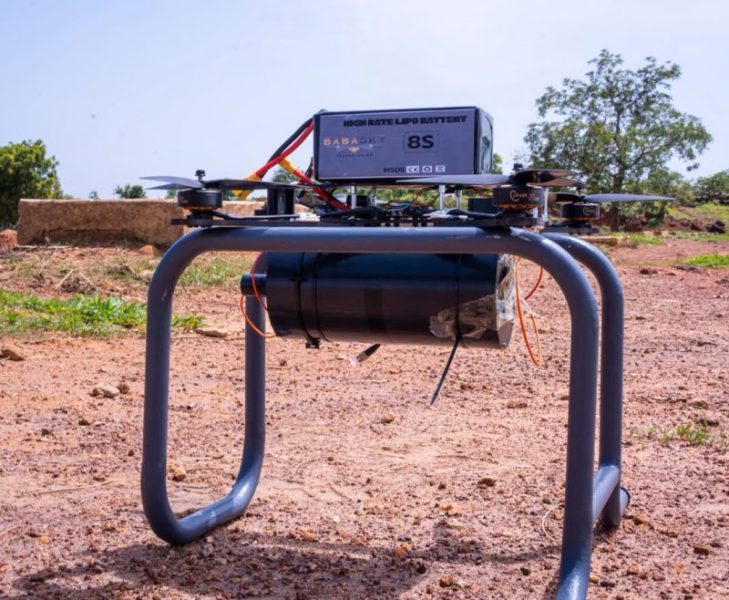
Nigerian drone manufacturer BabaSky Technologies has conducted flight tests of a fibre-optic guided loitering munition, the UNIKAM-FO1, at the Military Cantonment testing range in Jaji, Kaduna State. The company reports that the system underwent a series of trials in late June, with results published on 2 July 2026. BabaSky is a subsidiary of the UNICCON Group of Companies, an Abuja-based conglomerate that also develops Omeife, one of Africa’s earliest domestically developed humanoid robots. Engineer Ronald Ajiboye is the company’s Chief Executive Officer, and Professor Chuks Ekwueme chairs the broader UNICCON Group.
The UNIKAM-FO1 (Fibre Optics Kamikaze) is part of a broader family of first-person view (FPV) loitering munitions, small remotely operated drones guided by a human operator via video feed that BabaSky first introduced in December 2025. What distinguishes the FO1 is its control linkage. Instead of a radio channel, the aircraft trails a thin fibre-optic and Kevlar tether, transmitting video and commands through a physical wire rather than wirelessly. This design addresses a significant challenge that has transformed drone warfare over the past 2 years. Radio-controlled FPV drones rely on a clear RF link between operator and aircraft, which electronic countermeasures (ECM) target. Jamming, GPS spoofing, and video dropouts can incapacitate a wireless drone before it reaches its target. A wired connection circumvents this vulnerability entirely, as it eliminates the need for a signal to be jammed. BabaSky reinforced the tether with Kevlar to withstand tight maneuvers through wooded terrain, hills, and urban obstacles.
Regarding specifications, BabaSky lists a payload capacity of 2.5 kg, a maximum speed of 120 km/h, and an endurance ranging from 9 to 15 minutes depending on the payload. Range varies with the spool installed: 5, 10, or 15 km, according to the company’s data. The aircraft carries an indigenous high-explosive warhead and is operated manually. BabaSky also emphasized the arming sequence for the warhead. The detonation command is transmitted solely through the fibre-optic line to a dedicated initiation channel, thereby eliminating any risk of accidental detonation or interception over radio signals.
The trials at Jaji assessed the drone’s spool deployment, structural stability, and terminal guidance under realistic flight conditions. Equipped with a 5 km fibre-optic spool, the multi-rotor aircraft was launched from a ground frame, accelerated to maximum speed, and impacted a designated target in a direct ramming dive. A second set of flights tested maneuvering and line payout without a warhead, with the drone flown for approximately 5 minutes through obstacle courses before a controlled recovery landing.
The FO1 advances a broader initiative by UNICCON and its defence joint venture with the Defence Industries Corporation of Nigeria (DICON) to domesticize drone production. During a December 2025 demonstration at the same Jaji range, the group showcased the UNIKAM series of loitering munitions alongside a counter-drone system designed to detect and jam hostile UAVs and demonstrated a 2.2 kg indigenous composite warhead producing a blast radius of approximately 200 m. UNICCON has indicated that warhead variants of the UNIKAM family can scale up to 200 kg. The counter-drone system was described as capable of tracking over 40 UAVs simultaneously up to 8 km away and neutralizing threats within a 3 km radius through jamming and spoofing, a dual capability positioning UNICCON as a provider of both strike drones and defensive countermeasures.
Major General Babatunde Alaya, Director-General of DICON, attended the December event and expressed ongoing support for indigenous defense technology and regional collaboration. For Nigeria and neighboring countries, the necessity for a jam-resistant strike drone is clear.
Ekwueme characterized the UNIKAM programme as evidence that African engineers can independently design, construct, and test combat-relevant UAVs without reliance on imported components. “Our focus is on building indigenous capacity in advanced technology”, he stated, emphasizing the objective of involving Nigerian engineers in globally pertinent innovation. UNICCON asserts that every component of the UNIKAM drones and their munitions is sourced and produced locally. The company is also developing fixed-wing and long-endurance platforms, in addition to Kamikaze drones, for reconnaissance and strike missions beyond the operational range of multi-rotor platforms.