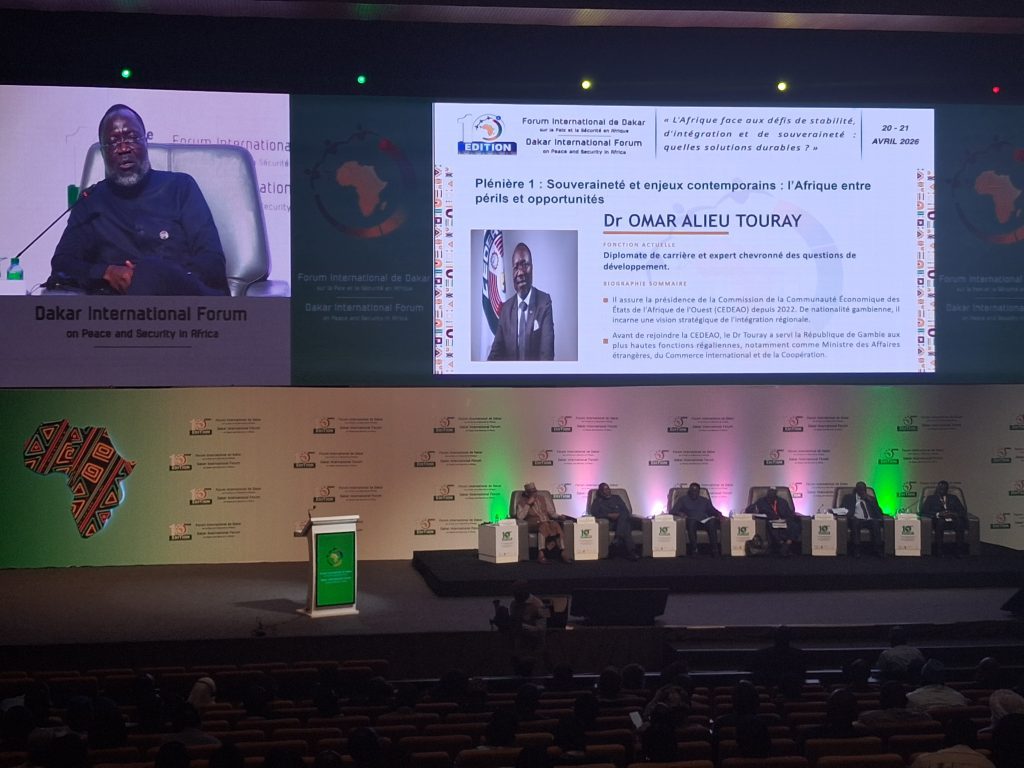
Dr Omar Alieu Touray, President of the Economic Community of West African States (ECOWAS) Commission, called for an African-funded regional standby force at the 10th Dakar International Forum on Peace and Security on April 20, 2026.
The forum, held at the Abdou Diouf International Conference Centre (CICAD) in Diamniadio, Senegal, addresses the theme: “Africa facing the challenges of stability, integration, and sovereignty: what sustainable solutions?” Touray, a Gambian diplomat who previously served as his country’s Secretary of State for Foreign Affairs and UN Representative, stated that West African nations must provide their own security funding rather than relying on foreign partners. He noted that several previous African Union (AU) missions were forced into “re-hatting” -a process where underfunded regional missions are absorbed into United Nations (UN) peacekeeping operations-due to severe budget and logistics gaps.
Historical examples of this transition include the African Union Mission in Sudan (AMIS), which became the hybrid UNAMID operation in 2004, and the African-led International Support Mission in Mali (AFISMA), which transitioned to the MINUSMA mission in 2013. Similar patterns occurred with the AU mission in the Central African Republic (MISCA) and the transition of AMISOM to the African Union Transition Mission in Somalia (ATMIS) in 2022. Touray emphasised that these shifts often stem from a lack of equipment and sustained financial support, which limits the autonomy of African defence strategies.
The current ECOWAS strategy focuses on the activation of the ECOWAS Standby Force (ESF), a multi-component entity including military, police, and civilian units. While the long-term vision involves a mobilisation of up to 260,000 personnel, the immediate operational focus is more concentrated. Commissioner for Political Affairs, Peace and Security, Abdel-Fatau Musah, confirmed that the 2026 deployment will centre on a Rapid Deployment Force (RDF) of 1,650 personnel. This vanguard unit is part of a larger 5,000-strong standby force designed to provide the region with an “organic kinetic capability”-direct combat power that does not rely on ad hoc troop contributions from member states.
Technical readiness for the ESF hinges on the ECOWAS Logistics Depot in Lungi, Sierra Leone. Recent assessments, verified on April 15, 2026, show the facility is over 90% ready. This hub will handle equipment storage, maintenance, and rapid dispatch, which is critical for securing porous borders. The move toward a structured, collective defence arrives as terrorism-related deaths in the Sahel now account for approximately half of the global total. President Julius Maada Bio of Sierra Leone, currently serving as the Chairman of the ECOWAS Authority, has stressed that the force is a necessary evolution of regional defence mechanisms formalised in late 2025.
The shift toward self-funding is intended to solve the “re-hatting” bottleneck by ensuring that defence chiefs and finance ministers can sustain operations without external vetoes. By centralising command and logistics in Lungi, the bloc hopes to create a more responsive shield against insurgent groups that exploit border zones for cross-border strikes. The full operationalisation of the 1,650-person RDF is expected by the third quarter of 2026, marking a notable transition from diplomatic coordination to active regional policing.